Scaling Humanity at the Speed of AI

AI can scale intelligence. Leadership must scale humanity.

A managing director in a global consulting firm, doing all the right things to drive AI adoption. It’s not paying off in results – and his people are frustrated.

“They understand the promise of AI,” he says, “but the tools are half-baked and often the opposite of productive.”

A bright young woman who joined a tech company to protect children online. She’s struggling with the company’s new AI-first approach.

“Please don’t force me to use AI,” she says. “It simply doesn’t protect children the way we need to.”

An AI research engineer in a big tech firm in Silicon Valley laments:

“Instead of thoughtful bets, we’re running hundreds of experiments a day – throwing AI at a wall and seeing what sticks. It feels like we’re losing our purpose as a company.

As I coach leaders and teams through AI transformation – from Silicon Valley to Singapore to London – these thoughtful but quiet voices inevitably surface.

And they are worth paying attention to.

As leaders driving AI adoption, what kind of organizations are we creating? Are humans truly becoming better at what we’re uniquely good at? Or are we moving in the opposite direction?

In this article, I cover common leadership blind spots in AI transformation, and the remedies.

Blindspot #1: Rapid AI adoption is inherently good

Truth: This is more about values than you think

In boardrooms, success in AI adoption is measured by speed: more experiments, faster rollouts, higher revenue, cost-cutting.

What leaders often miss is that AI doesn’t just bring tools – it carries an ideology: that efficiency and productivity are the highest good.

Left unbalanced, that ideology reshapes what organizations pursue, reward and value.

Earlier this year, I worked with one of the world’s leading journalism organizations. Top leadership brought us in because they feared the newsroom was too slow and resistant to change.

In my time with their global team of journalists and staff, it became evident that absolutely no one was anti-AI. They simply did not have a space to articulate values which felt threatened by the push towards productivity and efficiency.

“I joined this company because our journalism stands for intellectual rigor and detail. Though AI could summarize a thousand page report in cut my process by hours, I’m afraid I’ll miss out on the color and detail which makes our reporting unique. Do we really want to lose that?”

Their resistance was not due to slowness or tradition. Like the young lady working on online child safety, a core value – a reason for joining the organization – was at stake.

This is the first balance: As AI brings its powerful ideology of efficiency, each of us needs to articulate, acknowledge and double down on personal and organizational values.

Leaders can unlock wiser adoption by asking:

  • What do we truly value about how we work?
  • How does AI threaten or support those values?
  • How do we adopt AI in ways that strengthen our mission?

As we closed our “Art of Bridging” session, another journalist reflected: “By naming where AI threatens our values, we can now reframe — how to uphold our values while finding better ways of doing things.” The group walked away excited and activated, with dozens of new ideas to try.

Have that conversation. Don’t assume speed is progress.

(AI carries a powerful ideology that efficiency and productivity are ultimate vAI carries a powerful ideology that efficiency and productivity are ultimate values.

Recognize this, and ask which other organizational values need to be reinforced.)

Blindspot #2: AI skills are the silver bullet

Truth: There’s a much more foundational skill to impart – human agency

At a conversation with women in business, a preschool owner shared that she introduced AI learning to five-year-olds. The kids lasted minutes – they were far more interested in physical building blocks.

It was a funny story, but I think the kids understood something we forget: foundations come first.

In building organizational capabilities in AI, it is easier to build new tools or technical skills. But we all know that tools, especially AI tools, evolve. Foundations endure.

So that are the foundational skills in the AI era? In short, the skill of human agency.

In the AI age, human agents will use AI agents. If you are a human who waits for instruction and direction, your value will fall.

If you have the skill of agency – a view, a goal, a theory of change – AI will supercharge everything you do.

Here’s my simple equation for human agency:

Agency = Personal mastery + domain understanding

  • Personal mastery is the motivation, self-belief, and adaptability to navigate rapid change.
  • Domain understanding grounds that agility in industry context and judgment.

Human agency is THE foundational skill. Everyone – from intern to executive – needs the ability to set direction for domain and self:

  • What am I here to build in this next chapter?
  • What’s my vision for this domain?
  • What human–AI partnership will enable it?

Having lived in Silicon Valley for almost a decade (2016-2025), and now in Singapore, I’ve observed that this is one of the biggest differences in talent mindset. In the Valley, every person sees themselves as an agent. In more hierarchical cultures, it is more common to look to leaders or organizations to define these for us.

The first balance was about values. Balancing the force of AI’s efficiency ideology with the force of your organization’s other values.

This is the second: as AI agents become stronger, humans must become stronger agents too.

Don’t just push your people to adopt AI tools. Make sure they have the skills to be human agents who can use AI agents effectively.

(Put the foundational skills in place. Human agency is the basis of all growth)

Building organizations that welcome (not just cope with) change – HOW?

Generative AI is reshaping work faster than any system, or individual, can comfortably adapt. Where re-organizations once took place every six months, they now happen continuously.

This calls us to increase our level of ambition when it comes to managing change.

  • Where we now ask: “How to help people cope with change?”
  • We need a reframe: “How do we build a system that welcomes change, and thrives amidst it?”

This requires a paradigm shift in the way we build organizational capabilities.

1. Developing agency across the organization

Most leaders want “alignment” – and try to achieve it by cascading directions.

In rapidly changing organizations, alignment cannot be handed down. By the time it trickles through the layers, the information is outdated. People get confused. Burned out. Resentful.

Today, alignment depends on every person having a clear sense of purpose and agency in their work. That means activating each player to their own “why” for this chapter – and putting it in their court to connect this “why” to the organization’s evolving mission.

In an era of rapid organizational change, people and institutions will continually re-design their alliance with each other.

Rather than a career path, it is a two-sided conversation: Are we still the right fit for each other’s next stage?

Practically, every manager and team member needs the skills and space to:

  • Clarify their purpose and priorities for this chapter.
  • Connect their unique skills to the organization’s evolving mission.
  • Design the right partnership between human judgment and AI leverage.
  • Know when to evolve — when a new season or role would unlock greater contribution.

When people have the foundational skill of agency, alignment stops being something leaders enforce – it becomes something teams co-create.

This new kind of career literacy is what we teach in Navigating Shifting Seasons – equipping people and managers to navigate continual transitions with clarity, maturity, and mutual respect.

(Creating a system of agency naturally drives alignment. Don’t try to drive alignment from the top down.)

2. Building true organizational resilience

The second task of leadership is to ensure that organizations have inbuilt resilience — the ability to flex and rebound through change.

In living systems, pressure without capacity causes breakdown. The same is true for organizations. When the rate of change increases, the ability to process and recover must rise with it.

Most workplaces already understand physical safety – fire drills, ergonomic chairs, first-aid kits, and a ratio of trained responders to staff.

In the age of AI transformation, we need the equivalents for psychological and emotional safety, to help people thrive amidst the strain of constant change, the uncertainty of new tools, the pressure to adapt before understanding.

What are the new shock absorbers and trampolines – systems that help people process stress, recover faster, and bounce back stronger after disruption?

At Inherent, we’ve developed and published research on one such system: Workplace First Responders. These are not managers or specialists, but peers trained to recognize transition stress, offer empathy, and help their peers move towards agency and strategy. These first responders have boosted their peers’ motivation (+43%), focus and productivity (+50%), confidence (+60%), reduction in burn-out (-34%) in statistically significant ways, as published in our research with Princeton University.

By embedding this capacity, organizations normalize uncertainty, give teams shared language to respond, and create support structures inside the work system.

This is just one intervention, and I’d love to hear what other organizations are doing.

Ultimately, when leaders design organizations that can absorb and rebound from pressure, transformation becomes not a threat, but a rhythm – a cycle of stretch, recovery, and renewal.

“Change adds stress. But change leads to growth, not trauma, when there’s adequate counterbalancing support. We need to rethink organizational resilience in the era of constant change.”

AI can scale intelligence, but only leadership can scale humanity

In recent research by Workday , most employees (83%) believe that AI will make uniquely human skills even more critical.

But will humans naturally become better at what we’re good at? No. In fact, the way that AI is being adopted focuses on less thinking, more doing; less questions, more answers.

AI can scale intelligence. But only leadership can scale human strengths.

If you are leading AI transformation, I appeal to you to counterbalance speed, cost cutting and productivity with three important capability-building strategies:

  • First, deepen vision and values. As AI brings its ideology of efficiency, leaders must deepen the articulation of values that give organization’s work meaning.
  • Second, build human agency. Leaders must deepen each person’s human agency: capabilities to set vision, take action, and find the right human–AI balance for their work. Agency is a foundational skill which allows continual adaptation from tool to tool, technology to technology.
  • Third, design for resilience. Leaders must treat emotional and psychological capacity as seriously, if not more seriously as physical safety. We must build systems that help people bounce back stronger from change, not just endure it.

If AI scales intelligence, leadership’s task is to scale the qualities that make intelligence human – judgment, empathy, purpose, renewal.

That is how we’ll know the transformation is working: not when AI runs faster, but when people grow deeper.

Do get in touch to share your experiences and opinions! karen at inherentjourney dot com.

About the author:

Karen Tay is the Founder and CEO of Inherent, a Silicon Valley + Singaporean company which designs and delivers research-backed leadership programs for organisations navigating AI-driven change. She has worked with clients such as Google, Linklaters, The Economist Group, and travels globally for assignments. Inherent’s work integrates behavioural science, strategic leadership, and deep human development.

A Princeton University graduate, former Singapore Government leader (AO), and fractional Chief People Officer to growth stage start-ups, Karen bridges the worlds of technology, public service and innovation. She is also faculty at Singularity University and an ICF-certified coach. Her work has been featured internationally for creating learning spaces that are rigorous, human, and deeply relevant.

Teaching on “The Art of Bridging: Discerning Hype and Driving Sustainable AI Adoption” – to 100 executives in Silicon Valley

Tackling Job Displacement at Scale: My Ideal Solution

Job displacement is not new, but the scale and speed will increase in the coming years – a 2013 study by Frey and Osborne suggested that 47% of workers in America held jobs with a high risk of potential automation.

A few months ago, I wrote “Tackling AI-Driven Job Displacement: A Primer”, which argued that current avenues for people to retrain and find new jobs appeal mainly to those who are already motivated. When changing jobs is a choice, we don’t have a problem. However, when changing jobs is a necessity – which it will be as the speed of job displacement increases – we need the whole population to be motivated and proactive about re-skilling and finding new jobs.

How can we achieve this? For countries, this will be one of the defining challenges of our generation. If we cannot get a large proportion of our population to continuously re-skill to fit emerging jobs, we will face economic slowdown, increasing unemployment and most probably political upheaval.

In this article, I give a big picture of my ideal future, some of the outstanding efforts by tech companies and Governments, and the two big challenges that require collaboration.

My Ideal Future: The Big Picture

The job market today is wrought with inefficiencies which create barriers for job-seekers and employers.

  • For individuals, the job search is intimidating because most of us do not have a good understanding of our skills, and how these map onto other jobs. There is also little incentive to obtain new skills if the link between these skills and future employment seems tenuous. It is a simple cost-benefit analysis.
  • Employers are similarly in the dark. They can pay exorbitantly for skills that seem to be in limited supply when they unaware of people with adjacent skill-sets who could easily fill those roles with some investment in training. According to the Manpower Group, 46% of US employers reported that they had difficulty filling jobs.
  • Education providers can profit greatly from the lack of transparency, when people are willing to pay for credentials that have no bearing on employment outcomes. On the other hand, they may struggle to reach a wider audience because only motivated people are seeking out their services. Adult education providers suffer here.

Imagine a different future with me for a few seconds.

If you are a regular person who wants to stay employed

Imagine a day when making plans for your next job is as much a part of your life as making plans for your next purchase: the barriers to your job search are so low.

  • Just as you have a bank account, you have a skills account which elucidates all the skills you have accumulated through your education and previous jobs. These include self-reported skills, as well as skills that are verified by an authority that has studied the relationship between job descriptions and skills across sectors.
  • Just as Facebook and Google push you advertisements based on your click history, you are consistently notified about emerging jobs with a close skills match to your account.Good morning, we noticed that these jobs, which match your skillset, are trending. Salaries in these jobs are 5% higher than your current salary”.
  • Suppose these jobs are sorted by degree of match to your existing skillset – 90%, 80%, 70%. You click on one and get an assessment of the best next steps – “Hi Karen, looks like you’re an 80% match to this job, and people with your profile have successfully entered this job by [taking this course] [doing a side project in this area] [taking a 1-month internship with X company]. Click to proceed”.
  • You are also notified if your job is at risk, and nudged to take action. “Based on trends, your ‘risk modelling’ skill is increasingly automated by companies. Job listings for this are are decreasing at a rate of 5% a year and this is expected to speed up. Here are some adjacent skills you should pick up ASAP.”

When it’s so easy, won’t more people start to inculcate this as part of their lifestyle?

If you are an employer

Now imagine you are an employer. You need the right talent to serve emerging needs and want to access this talent, fast. Imagine if you not only had access to candidates who applied for their jobs, but candidates who had a >80% match to needed skill-sets, and could be a perfect fit if they underwent prescribed training or certification. You could reach out to these individuals and nudge them towards this, or sponsor training where it makes economic sense.

Rather than firing staff when functions are automated, you may prefer to move them into emerging jobs within the company, as long as the cost is not prohibitive. What if you could assess the degree of match between a potential lay-off with all the emerging jobs in your organization? This could help you make a choice on whether to invest to train the potential lay-off for these roles, or to favour of a new hire.

The information and incentives are better aligned to help you invest in training, rather than to go through rapid cycles of hiring and firing, which could undermine the fabric of your company.

If you are an education or training provider

Now imagine you are an education or training provider. When your courses are not standalone units but part of a pathway that quantifiably increases someone’s chances at securing an emerging job, your user base will likely increase. With more employers investing in education and skills training, your revenue also increases.

If you are a country Government

Now imagine you are a country government who has realized that the traditional model of centralized labour force planning is far too slow for the rate of job displacement. You can breathe easy because there is no longer a need for this outdated method. Individuals are motivated to reskill by good information and clear outcomes. Employers are willing to invest in training that will bring them the skills they need. Training providers fill real gaps and less people are overspending on education that yields little outcomes. The market is finally working – not just for the motivated few, but for your whole population.

Existing Efforts by Tech Companies are Laudable, but Insufficient

What I have laid out is pretty ambitious. It requires:

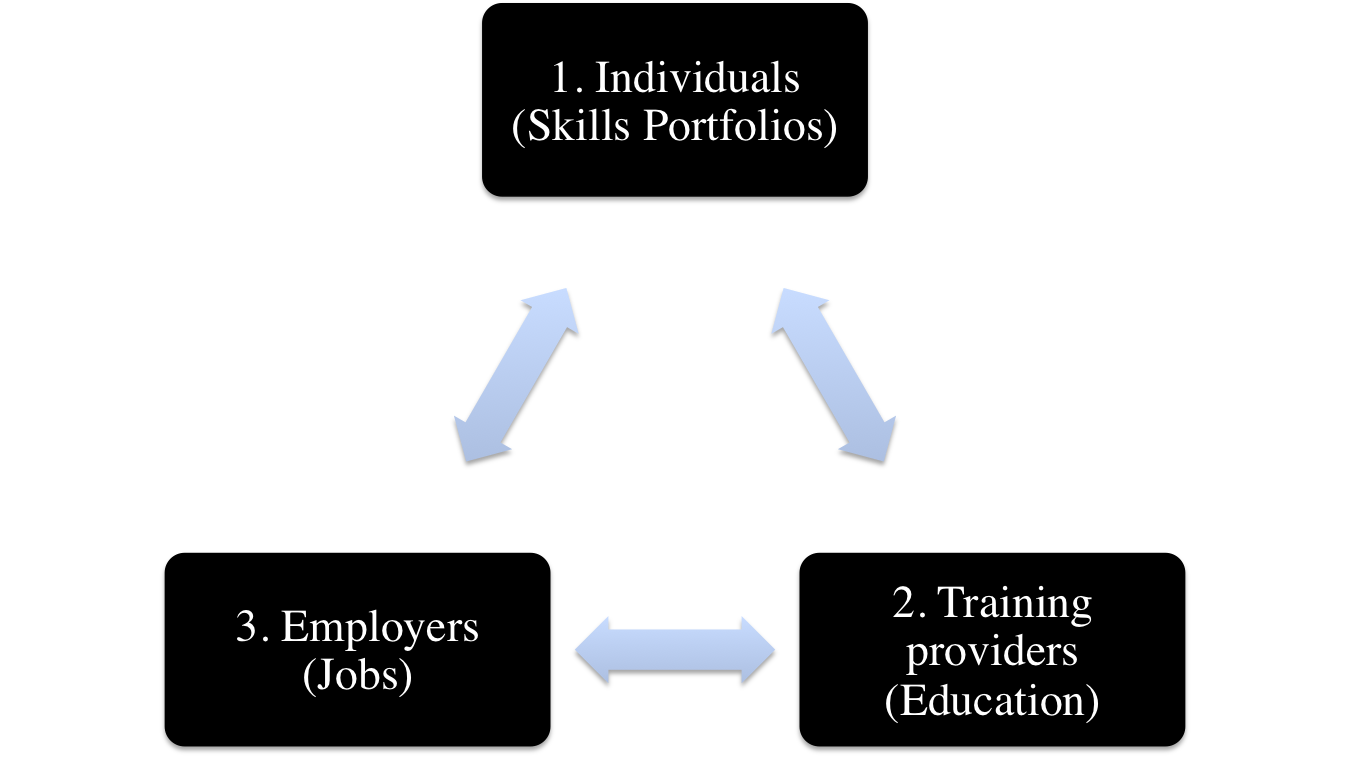
  • A closed loop between individuals, training providers and employers (graph below). Having a common language to describe skills and jobs lies at the core – if we continue to describe the same skills and jobs in different words, employers do not know the full extent of their candidate pool, job-seekers do not know where they fit, and educational institutions do not know how their programs really help. It’s the wild, wild west.
  • User-centric design that caters for the full range of our population: from the highly-motivated time-rich youth, to time-strapped parents and people who have worked in the same industry for decades. Some may not even use the internet. Employers similarly have to come on board – from the large multinationals to our mom and pop shops.

skillsarticle

Several companies have already been working on parts of this puzzle. For example:

Google for Jobs, announced in June this year, leverages its powerful search engine to pull jobs which are most relevant to job searchers. To achieve this, Google’s powerful machine-learning model normalizes jobs and skills which are described very differently by employers and users. For example, if you search for “collections call centre job”, google will be able to flag out all the jobs that you will likely be interested in, even those that include none of your search terms, e.g. “Revenue Management and Care Representative.”

In my opinion, no one is better placed than Google to do this because of their experience with relational models, which group relevant search terms and results. Relational models form the fundamental basis for how Google yields relevant results even when you are not sure how to search for it. I wrote about how Google uses relational models in health search here, which has strong parallels to the job search.

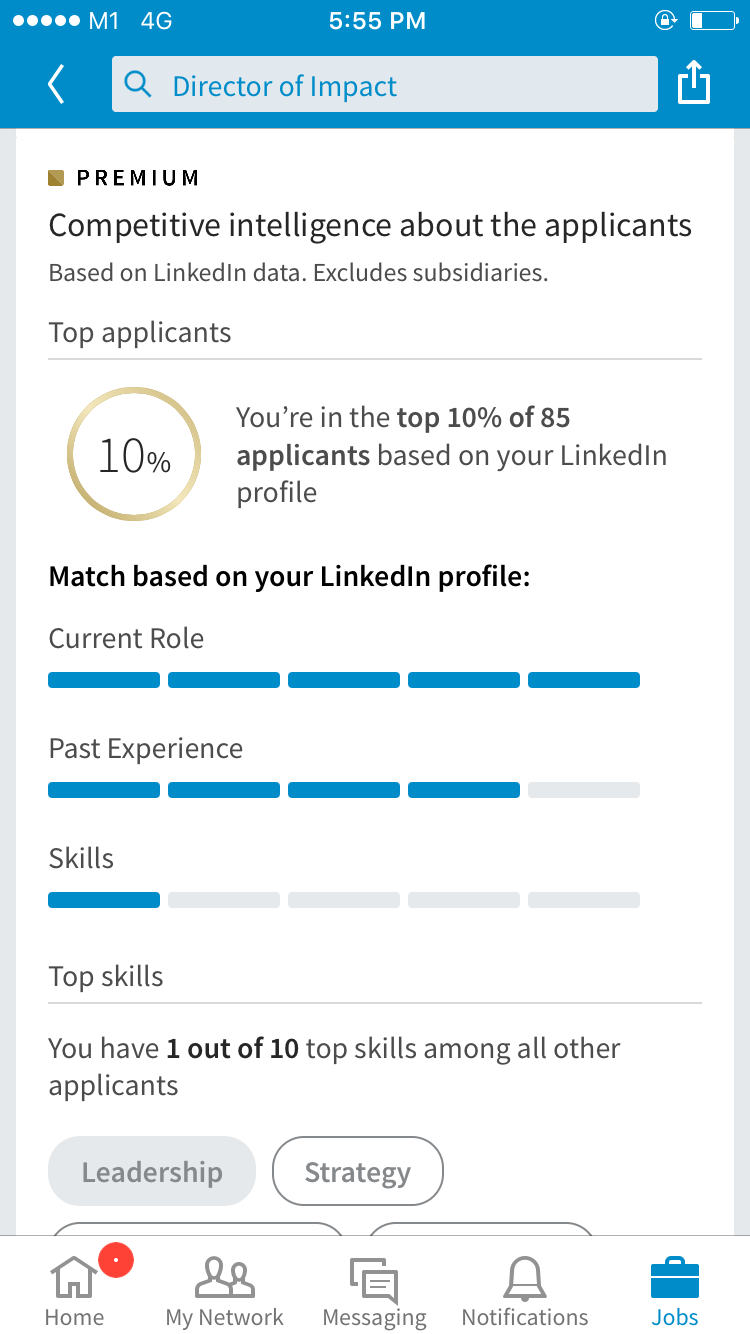
Linkedin is well-positioned to create a closed loop between job-seekers, training providers and employers because all these players are in their platform. Linkedin helps individuals develop their skills portfolios through self-reporting and endorsements. It is also starting to map individual skills and jobs. If you have a premium subscription, you can see how your skills compare to other candidates and the percentile of applicants you fall into based on your Linkedin profile (example below). With the acquisition of Lynda.com, Linkedin is increasingly able to recommend courses to help people up-skill towards their desired job outcomes. To provide greater transparency to job seekers and employers, Linkedin’s Economic Graph team is also mapping the demand and supply of various skills across the world. However, Linkedin’s current business model is expensive for users, which could exclude a large part of the population and limit the data it collects.

linkedinpic
Linkedin: initial efforts at mapping skills to jobs

Start-ups are also playing important roles in this ecosystem. Just two examples:

  • Interviewed, an SF-based start-up, helps to close the loop between skills training and jobs. It started out by successfully developing a range of assessments to help employers assess the skills of candidates. It has since developed platforms such as Rightskill, where employers commit to hiring or at least interviewing people who obtain a certain score on hosted course. MooCs like Udacity have also made strides to closely link skills training to job placements – an essential move if they want to motivate a wider population.
  • JobKred, a Singapore-based start-up, uses predictive analytics and data science to connect job seekers to their best opportunities, recommend personalised learning plans, and help employers zero in on their top prospects. They provide a customised user experience in the job search, making the job search less frightening.

Two Big Challenges Ahead

The creativity and experience of these companies will go a long way to achieving my ideal future. However, there are two big challenges ahead that I hope companies, Governments and non-profits will tackle together.

First, aligning the way that everyone describes skills.

Google has made leaps in working out the objective relationship between skills and jobs on the back-end. Their relational model is based on proprietary occupational and skills ontologies that they built in-house.

  • Google’s occupational ontology gives a top-down understanding of 1,100 job families, a task typically undertaken by Governments.
  • Google’s skills ontology maps out 50,000 hard and soft skills and the relationships between these skills.
  • The skills and jobs ontologies are then mapped onto each other to paint an objective picture of the hard and soft skills required in each job, regardless of how they are described.

This is an amazing first step – let’s just take a moment to appreciate it. The fact that they make their relational models available through the Google Cloud Jobs API is even more amazing.

However, I believe these ontologies should not be kept on the back-end, used only when someone conducts an internet search for jobs. Many aspects of the job and education journey take place offline. Constraining the benefits to people who make proactive internet searches may miss out on a huge swathe of potential job-seekers.

Public and non-profit organizations should help with nudging individuals, employers and training institutions towards describing skills and jobs in the same language – perhaps Google can consider working with Linkedin, to combine Google’s job and skills ontologies with Linkedin’s data on self-reported skills, and make these a shared resource. However, the business model must make sense for the companies. Instead of users, Governments, charities or philanthropists should pay as this is a public good.

To reach the widest population, we also need to proactively help individuals populate and manage their skills accounts, just as they manage their bank accounts. UX designers need to work on interfaces that give people a bias to action. I covered some ideas in my “ideal future” section.

Second, bringing users on at scale to enable powerful Artificial Intelligence.

AI will play a huge role in enabling my ideal future: it underpins recommender systems and relational models, just to name a few areas. In turn, these AI-powered systems are enabled by data. Here we face a chicken-and-egg issue: unless we bring on the wider population to use the system, the software will not be able to serve the wider population. To collect data, we need to bring employers, individuals and educational institutions onto this system at scale.

This is an area where technology companies will benefit from the help of public and non-profit institutions. Singapore’s decision to give every citizen $500 for skills training and to create a unified skills and jobs database for individuals is a first step towards bringing a larger segment of the population on board. For segments of the population who are not digitally savvy, we need humans to come alongside and help them get onto the system.

Final thoughts

My ideal future is one where everyone – not just the highly motivated, time-rich or digital savvy – is empowered to continually update their skills and move to emerging jobs, rather than get left behind in the wave of job displacement. Finding your next job must be made as easy as finding the next place you want to eat at.

In all likelihood, this vision will not come through 100%. New safety nets must be put in place for people who simply cannot find new jobs. However, I believe that keeping people in jobs must be our utmost priority: not only are jobs the best safety net, there is also something dignifying about work that I do not believe can be replaced by a handout.

The goal of motivating a population at scale and overcoming inefficiencies in the job market is an area ripe for solutions by technology companies. I am encouraged that many – from conglomerates to start-ups – are working hard to achieve this vision. At the same time, I want see more collaborations that will enable large segments of our population to benefit. I would love to hear your thoughts – what would you like to see in this space?


Tackling AI-driven job displacement: A Primer

I’m starting a series of posts on solutions to AI-driven job displacement.

I want to answer one big question: in light of AI-driven job displacement, what technology and policy innovations do we need to give people a great sense of hope for what the future holds?

I use the word “hope” because it is the prospect of a better future within reach which will inspire people to continually re-invent themselves when they face setbacks like job loss, rather than to give up. It’s not enough to give them concessions.

Lots of great articles have diagnosed the problem of technology-driven job displacement. A quick summary with links to articles I really enjoyed:

  • In the long run, there will be a net positive in jobs, but in the short run there will be pain: especially among the middle class. The White House published a useful overview on the impact of AI on society last December and Gary Bolles has great resources to understand the hollowing out of the middle class. One very concrete example of middle-class job loss: as shared mobility becomes an increasingly attractive option for city-dwellers, less people will feel the need to own a car. The GMs, Fords, Toyotas and Tier-1 suppliers of the world will scale down their manufacturing business and move into new lines such as mobility services. New jobs will most definitely be created – for example, operators who manage fleets of autonomous vehicles and software engineers whose algorithms will continually improve the cost and energy efficiency of fleets. It’s likely these jobs will hire new people, not those who were displaced.
  • Progress is at stake if we can’t give people the confidence that the new system will work in their favor. We see this in widespread support for anti-trade platforms, even though no economist doubts the overall benefits of trade. America has taken a few steps back, and while some of this may be attributed to the ignorance of one man, it is also the collective anxiety of people speaking through their votes – and this anxiety is not unfounded. This is not a particularly American problem. Brexit is the other most popularly cited example, but you see it everywhere, both in the developed and developing world: Egypt, the Philippines, Singapore: a push back among those who feel that the system no longer works in their favor.

So when it comes to job displacement, it’s not a matter of “us” and “them”. It affects all of us, albeit differently.

Here’s the challenge: how can we make the future full of hope for everyone – so that broad-based support for technological progress will push us all forward?

A Framework to Understand our Target Group

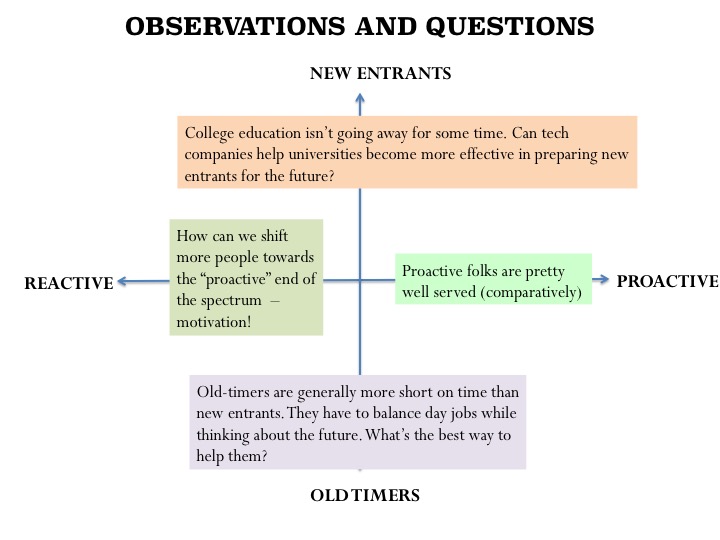
To start off, it’s useful to have a framework to understand the universe of people we need to reach. I offer two dimensions that differentiate people in our target group.

Slide2.jpg

*these are just illustrative examples! Obviously, the reality is a lot more nuanced.

Proactive vs Reactive

On one end, we have people who are “proactive” about keeping themselves relevant to the job market. Geeks like my husband, who completed a dozen Coursera/Udacity courses, taught himself new coding languages, mastered Tableau and ran a successful math blog, all while managing his day job.

On the other end we have people who are “reactive” – they are hardly thinking about the possibility of losing their job; even if they are, they aren’t taking action. This could be the 45-year old who worked a 9-5 job for the past 20 years or a new parent who has no bandwidth to think about anything but the present.

Inherent personality traits are one determinant of where a person falls on this spectrum. Life stage is another – it affects how much time we have to think about alternative plans. The prevailing culture of family and community also shapes what we value such adventure or stability, ambition or work-life balance. Much of this is determined by geography.

Where someone falls on this spectrum is never static. People can shift left and right, and motivation is key.

 New Entrant vs Old Timer

The “new entrant” vs “old timer” distinction is useful in framing solutions. To illustrate this, let’s imagine Uber can fully automate all its fleets by 2025, and will no longer need human drivers.

“Old timers” are existing Uber drivers. The challenge is to give them sufficient fore-warning of impending job loss, and opportunities to pivot into new industries. The difficulty is in encouraging them to take action before it’s too late, and to ensure there are good alternatives.

“New entrants” are those who will be entering the job market in 2025. The challenge is to equip them with skills that will be relevant to the job market in 2025, including skills required to operate Uber’s fleet of autonomous vehicles in localities throughout the world. The difficulty is that no one knows exactly what skills will be needed in 2025, and how many jobs will require these skills.

Here are some topics I’d like to address based on this framework.

First, most solutions today address those who are “proactive” – it’s the easiest group to address because it’s sufficient to make learning resources available; they’ll find them and take them up. How can we motivate or guide those who fall into the “reactive” half of the framework? What can tech companies do? What can Governments and employers do? How do these efforts tie together?

Second, how can tech work with higher education institutions to prepare new entrants (our children today) for the future job market? About five years ago, some predicted the death of higher education institutions as Massive Open Online Courses took off. Now, most of us acknowledge that this is not going to happen at a large scale any time soon. Most people aren’t as confident enough to ditch traditional paths, even if these don’t make sense anymore. How can tech companies help to reform higher education and make it far more responsive to the job market than today? I will draw on my experience working in higher education to address this question.

Third, what social security policies do we need in an era of accelerating job displacement? In the Silicon Valley, the idea of a Universal Basic Income – where everyone receives a basic monthly stipend from the state – has gained much traction as a policy solution to job-displacement. How will a Universal Basic Income impact the different groups in this framework? What are the alternatives or complements to a Universal Basic Income? I will draw on my experience working in and studying social policy to address this.

A summary here: Stay tuned!

slide3